Visual Permeability-Driven Generation of Support-Free Stochastic Porous Structures
Published in CAD (presented at SPM 2026)
* Corresponding authors.
1Peking University 2Shandong University 3Chinese Academy of Sciences
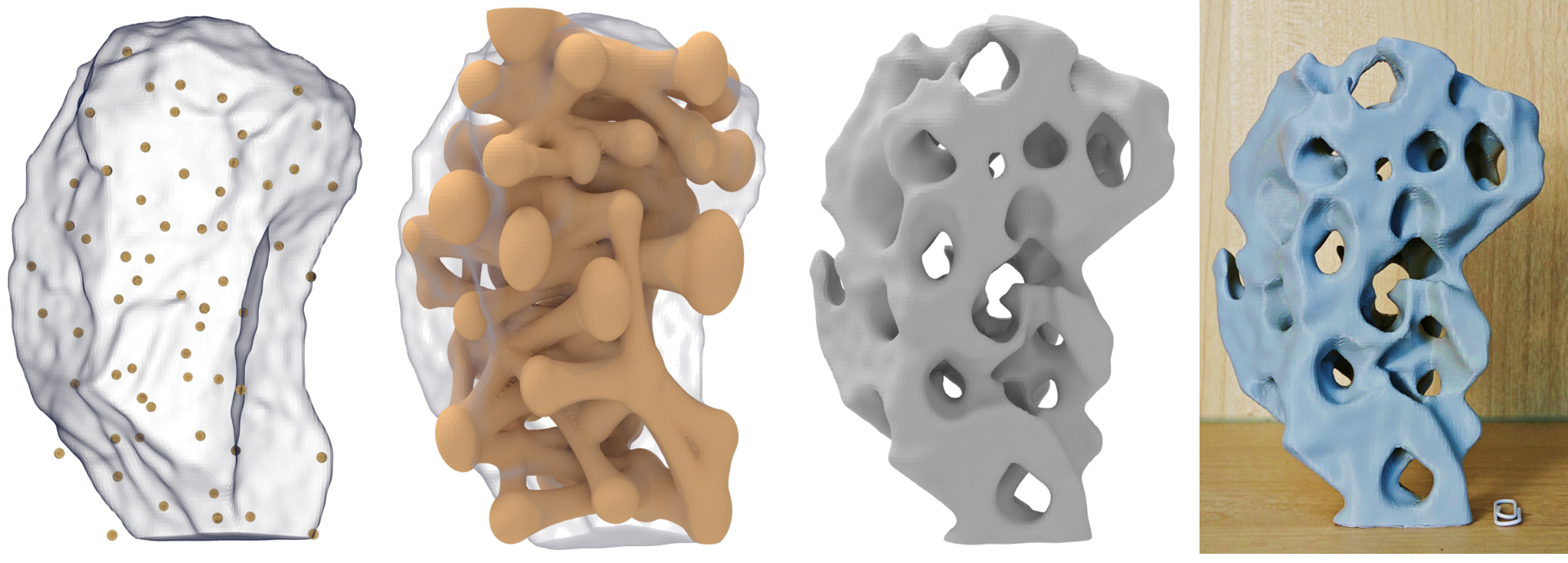
A computational framework for generating visually permeable and support-free stochastic porous structures.
Abstract
While stochastic porous structures are prized for their aesthetics and lightweight properties, they remain challenging to create and manufacture. Key challenges include design difficulty, manufacturing constraints due to internal supports, and a lack of metrics to evaluate visual permeability (VP). We propose a three-stage generation and optimization framework to bridge the gap between procedural design and digital fabrication. First, a novel quantitative VP metric is used to drive a graph-based connectivity optimization process that maximizes aesthetic transparency and structural sparsity. Second, orthotropic Gaussian-kernel implicit fields are used to model the continuous stochastic porous geometry, intrinsically reducing initial overhangs. Finally, a density-field optimization, constrained by a differentiable layer-wise additive manufacturing (AM) filter, is applied to enforce support-free manufacturability with minimal geometric distortion. Our method facilitates the creation of complex, highly permeable porous structures that can be seamlessly fabricated without the need for additional support.
Pipeline

An overview of our three-stage generation and optimization framework, including graph-based connectivity optimization driven by our VP metric, orthotropic Gaussian-kernel modeling, and differentiable AM filter optimization for support-free manufacturability.
Generated Results
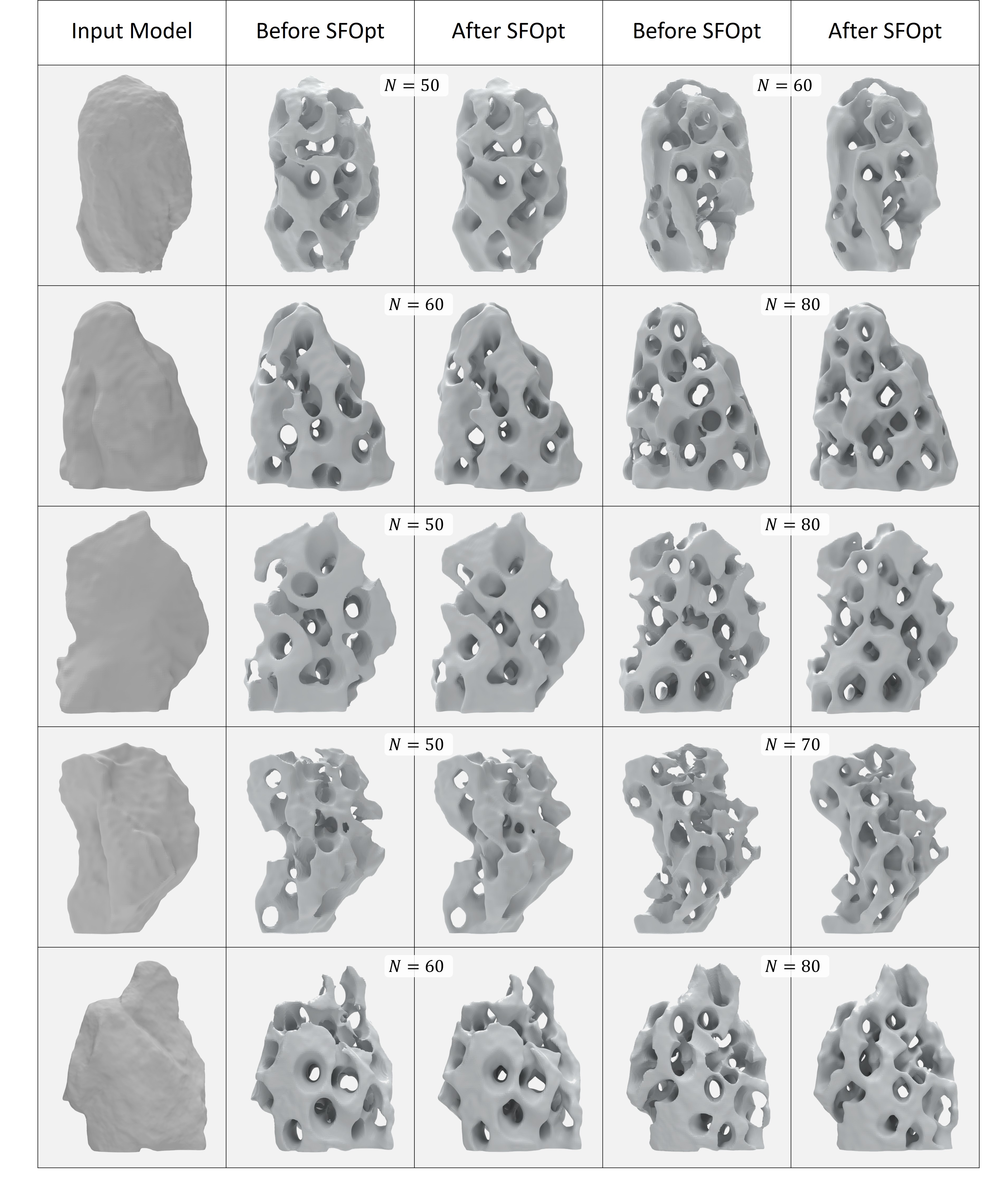
Generated stochastic porous structures exhibiting high visual permeability.
Fabricated Models
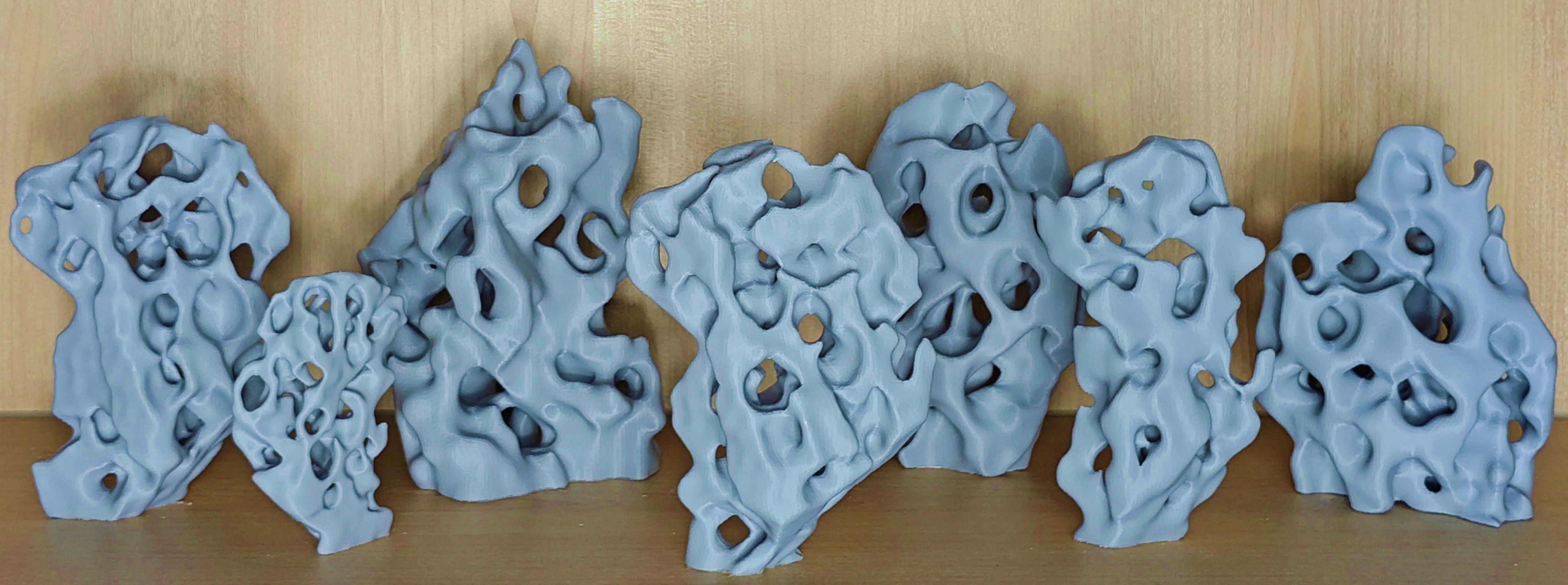
Physical models fabricated without additional internal supports.
Downloads



Acknowledgement
We thank all the reviewers for their valuable comments and con-structive suggestions. This work was partially supported by the Na-tional Natural Science Foundation of China (Grant No. U25A20438, 62472258 and 62595772).
BibTex